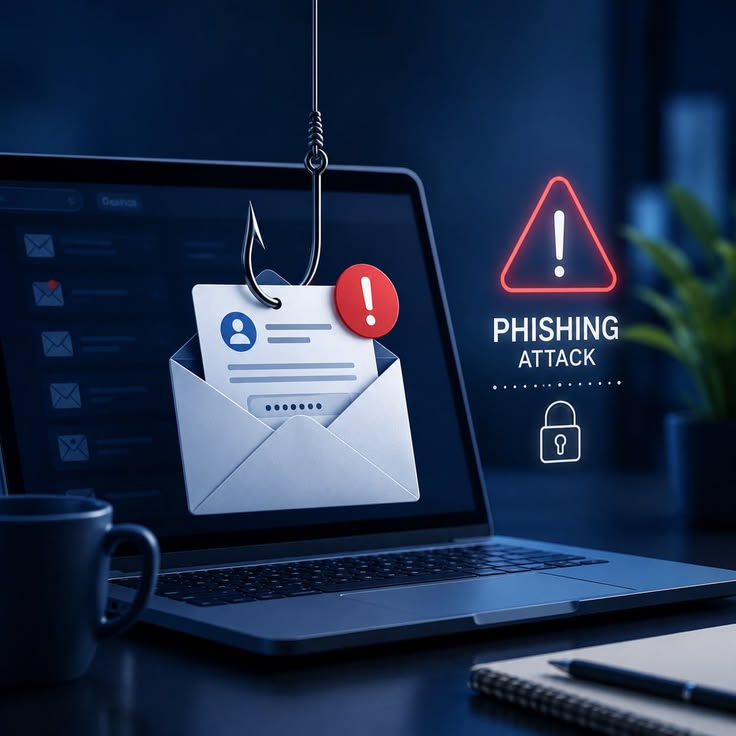
A text says your parcel is stuck. An email claims your bank account is locked. A call warns you about a charge you never made. At the moment, it feels urgent and real — and that's exactly how cyber criminals trick millions of people every single day. Here are the most common cyber threats people fall for in 2026, and how to stay safe.
Why phishing works so well
Phishing remains the number one cyber attack in the world, responsible for over 90% of successful data breaches. It works not by hacking systems, but by hacking people — using fear, urgency, and trust.
And it's getting harder to spot. With AI, scam messages are now grammatically perfect, highly personalised, and incredibly convincing. In fact, even senior executives are 23% more likely to fall for AI-driven personalised attacks. No one is immune.
The most common scams people fall for
1. Fake bank & account alerts
Messages pretending to be from HDFC, ICICI, SBI, or Axis Bank claim your account is locked or needs KYC verification — pushing you to click a link and enter your details.
2. Parcel & delivery scams
"Your package is pending. Pay a small fee to reschedule." These fake delivery notifications are everywhere, especially with online shopping at an all-time high.
3. UPI & payment scams
In India, fraudsters send small amounts pretending to be a contact, then exploit the "received money" trust to trick victims. Fake electricity bills and LPG booking links have surged too.
4. Smishing (SMS phishing)
Fraudulent text messages with malicious links — one of the fastest-growing threats, with hundreds of millions of attempts a year.
5. Vishing (voice phishing)
Scam calls impersonating banks, police, or officials, pressuring you to share OTPs or transfer money.
6. Quishing (QR code phishing)
Malicious QR codes in emails, flyers, or even shops that lead to fake login pages. Because scanning feels harmless, people rarely suspect it.
7. Job & investment scams
Fake job offers and "guaranteed return" investment schemes that steal money or personal data.
The newest threat: AI voice clones
The fastest-growing scam of 2026 is AI voice cloning — where criminals mimic the voice of a family member or boss to demand urgent money transfers. It sounds exactly like someone you trust, which makes it terrifyingly effective.
How to protect yourself
- Never click links in unexpected messages — go to the official website or app directly
- Never share OTPs, passwords, or card details, no matter who's asking
- Check for urgency and fear — that's the scammer's main weapon
- Verify suspicious calls or messages through official channels
- Be cautious with QR codes and unknown Wi-Fi networks
The golden rule: if something feels urgent and too good (or too scary) to be true, pause and verify.
The bigger picture — and the opportunity
As these threats grow, so does the need for skilled cyber security professionals who can stop them. Cyber security is now one of the most in-demand career fields in the world, with a global shortage of trained experts. Understanding how these attacks work is the first step — not just to staying safe, but to building a career defending others.
Frequently Asked Questions
What is the most common cyber threat in 2026?
Phishing is the most common, responsible for over 90% of successful data breaches — including email phishing, smishing, vishing, and QR code scams.
Why do people fall for phishing so easily?
Phishing exploits human emotions — fear, urgency, and trust — rather than technical weaknesses. AI has made scam messages more convincing than ever.
What are common phishing scams in India?
Fake bank KYC alerts, UPI payment scams, parcel delivery fraud, fake electricity bills, and job or investment scams are among the most common.
What should I do if I click a phishing link?
Disconnect from the internet, change your passwords immediately, enable two-factor authentication, and alert your bank if financial details were shared.
Is cyber security a good career in 2026?
Yes. With rising threats and a global skills shortage, cyber security offers strong demand, high salaries, and meaningful work.